Three Maneuvers for Modern Flow

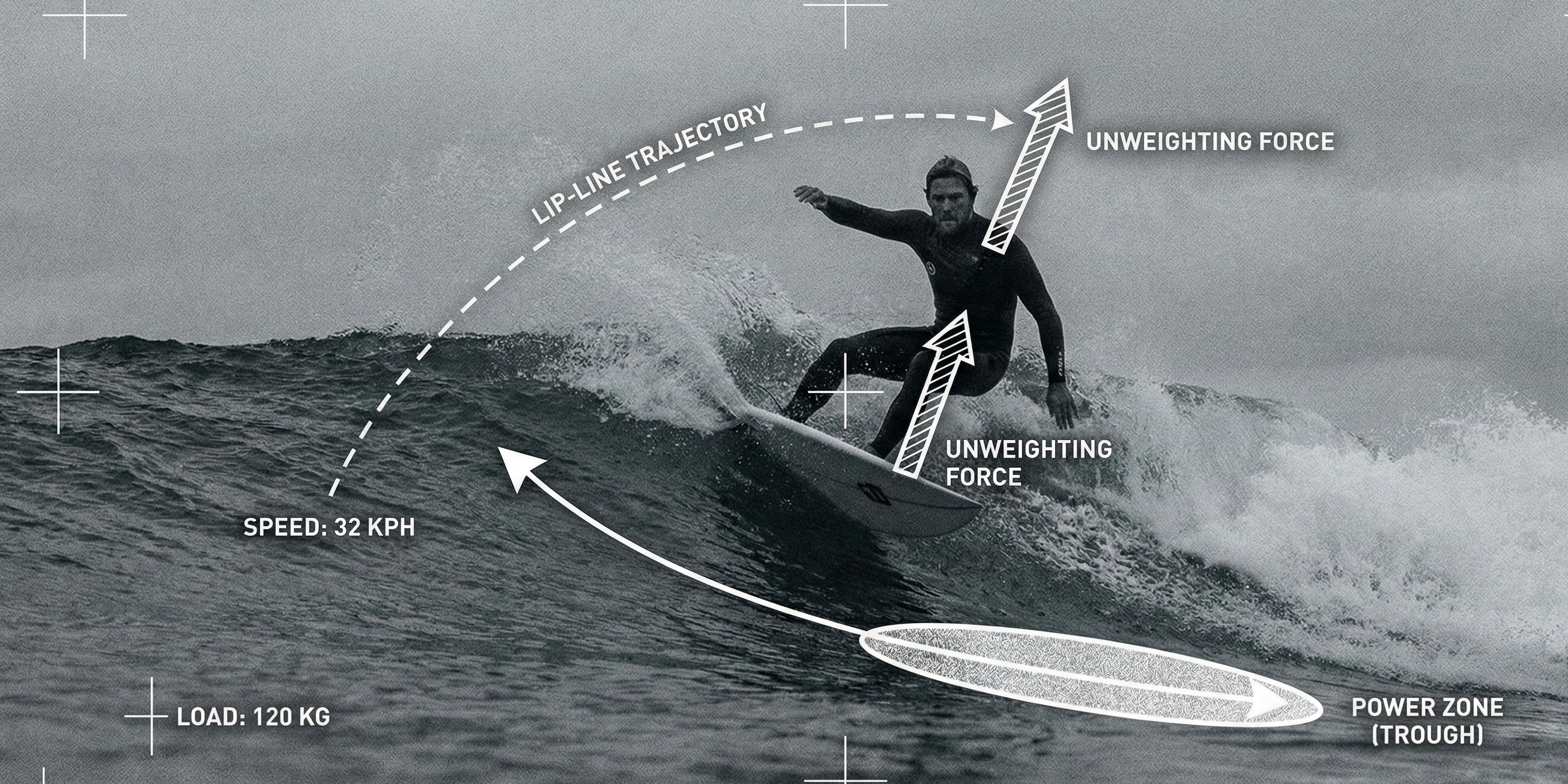
TL;DR: Flow is the result of weight distribution and shoulder orientation. Master the 80% front-foot bottom turn, the "cheek-touch" pump, and palm-to-foam carving to unlock vertical sections.
High-performance surfing is a science of movement, not a matter of "letting go." To evolve, you must apply a limited focus to the mechanical details that dictate whether a board bogs or flies. Most importantly: Speed is harvested from the high line, not manufactured in the flats. If you drop to the trough to start your work, you’ve already lost the section.
1. The Bottom Turn: The Projection Pivot
The bottom turn is a functional setup. Its sole purpose is to project the board to the lip with timing and velocity.
Legacy vs. Modern Weight Bias
- Legacy Approach: Standing neutral or back-heavy, causing the board to "push" water.
- Modern Approach: Drive 80% of your weight onto the front foot at the entry. This engages the rail early and allows the board's rocker to do the work.
Legacy vs. Modern Shoulder Elevation
- Legacy Approach: Shoulders level with the water, limiting the vertical arc.
- Modern Approach: Your front shoulder must be higher than your back shoulder. This rotates the upper body and pulls the board up the face.
Coach’s Cue: "Wait for the rail to bite before you shift weight to the back foot. Pull the trigger too early and you’ll stall in the trough."
2. Carving: Edge-to-Edge Redirection
Carving is the art of redirecting velocity back toward the power source. The failure point is almost always the entry geometry.
Legacy vs. Modern Body Geometry
- Legacy Approach: Stiff legs and a squared-off stance in the middle of the wave face.
- Modern Approach: Enter the carve with the front leg completely extended and the back knee flexed. This creates a "V" in your stance for maximum torsion.
Legacy vs. Modern Palm Rotation
- Legacy Approach: Lazy arms or "arm waving" for balance.
- Modern Approach: Rotate your front palm so it faces the foam diagonally. This hand orientation stabilizes the board’s edge and forces the shoulders to follow the line.
3. Pumping: High-Line Torsion
Real speed comes from "unweighting" the board. If you lower yourself to the flat to pump, you are fighting gravity.
Legacy vs. Modern Projection
- Legacy Approach: "Wiggling" the board or maintaining static weight throughout the pump.
- Modern Approach: Start from a mid-high line. Rotate the front shoulder upward until it nearly touches your cheek while adding a small "jump" with the lower body. This momentarily unweights the board, allowing it to "jump" toward the top of the wave.
Coach’s Cue: "Shoulder to cheek. If your front shoulder isn't climbing, your board isn't generating speed."
The Next-Session Blueprint
- The Pre-Surf Observation: Watch the top 30% of the wave face. Identify exactly where the high-performance surfers initiate their carves. Watch for the "shoulder-to-cheek" movement during their pumps.
- The In-Water Drill (The 80% Entry): On your first three waves, over-exaggerate your front-foot weight. Lean into the front foot until you feel the rail "bite" into the trough, then transition to the back foot to aim for the lip.