How Rail Engagement Actually Works

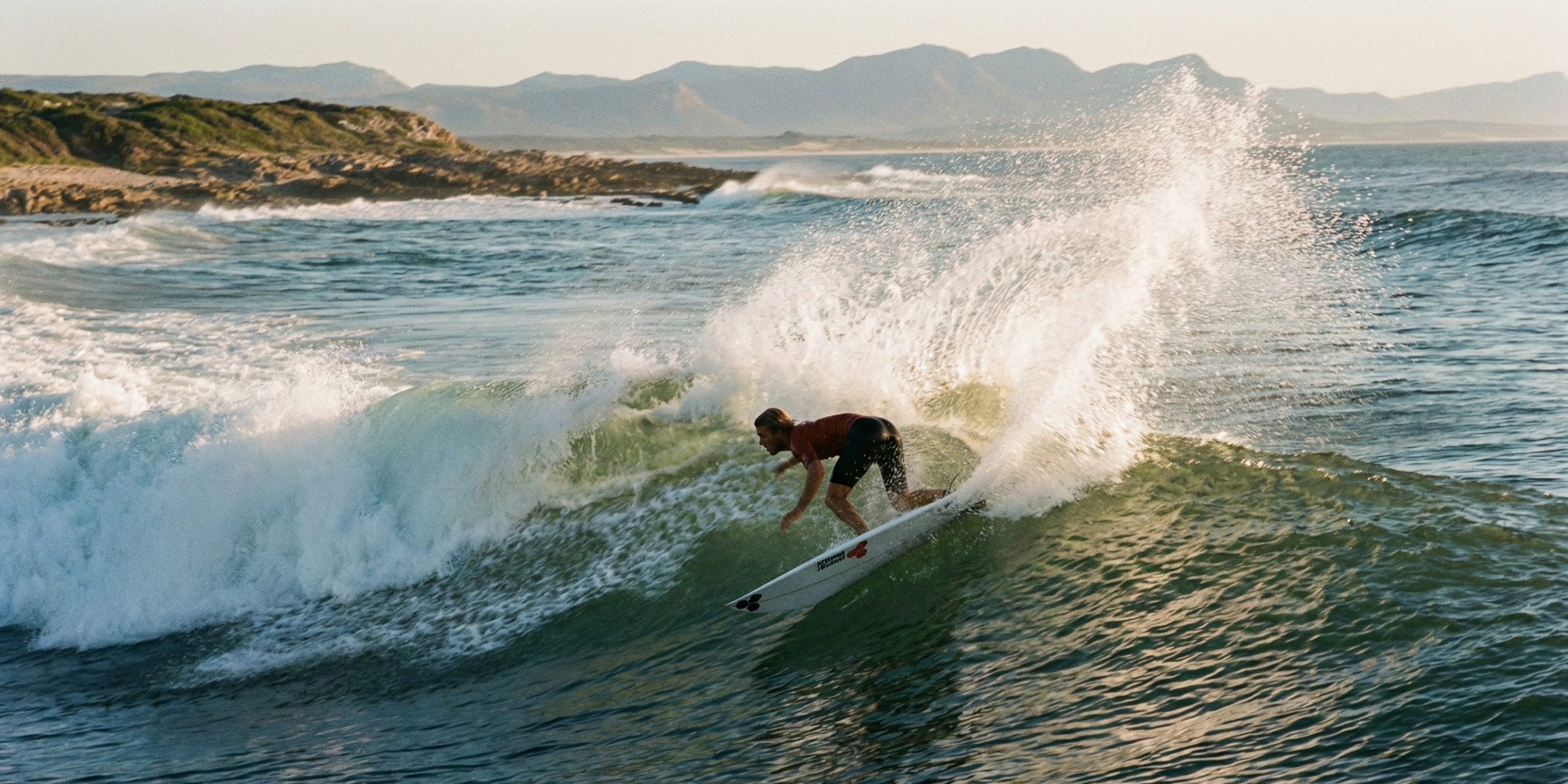
TL;DR: Style is the visual evidence of mechanical efficiency. Stop "pumping" flat and start utilizing constant rail oscillation to harvest speed from the pocket. Quiet upper bodies are only possible when the lower body is under constant tension.
How Rail Engagement Actually Works
The "Style-Foundation" trap is simple: surfers try to look relaxed by loosening their movements. In reality, style is the absence of corrective movements. When your rail engagement is continuous, the board produces its own speed, allowing the body to appear "quiet." If the board goes flat, you have to "muscle" the speed back, which looks stiff and forced.
To Look Relaxed, You Must Be Rigid
True flow comes from lower-body tension. If your legs aren't actively managing the board's connection to the face, the board will "chatter" over the chop. Mechanical rigidity in your stance creates the platform for aesthetic "slack" in your arms.
Technical Contrast: The Flat Board vs. The Active Rail
1. Speed Generation
- Legacy Approach: Pumping the board flat on the water's surface to "glide."
- Modern Approach: The "Cork Effect." Constant rail-to-rail oscillation that converts buoyancy into forward projection.
2. The Vector of Drive
- Legacy Approach: Hunting for speed on the shoulder away from the power.
- Modern Approach: Submerging the rail in the pocket. The board is either on the inside or outside rail, never settled in the middle.
3. Surface Friction
- Legacy Approach: Increasing surface area contact by keeping the board parallel to the water.
- Modern Approach: Minimizing drag by keeping the board on edge, slicing through the surface tension rather than slapping against it.
Coach’s Cue: "Sink the edge until the water feels like a solid track. If the board feels 'light' or 'chattery,' you're too flat."
Leading with Intention: Functional Arm Geometry
Mikey February and Ethan Ewing have different aesthetics, but their mechanics are identical. They use their upper body as a torsional lever.
The Front Arm (The Compass)
Your front hand dictates the "horizon line." It must point toward your target—the lip-line or the trough—before the board follows. If the hand is lazy, the turn will flat-line.
The Back Arm (The Motor)
The trailing arm is the rudder. It "pushes" through the arc, keeping the center of gravity centered over the stringer. This prevents the "stink bug" wide-knee stance that occurs when a surfer loses balance in the trough.
Pocket Navigation: Potential vs. Kinetic Energy
Style is often just smart positioning. Racing to the shoulder is a "section-checker" move that kills potential energy.
- The High Line: Staying high on the face to store energy.
- The Rebound: Using the foam as a "reset" button. Hit the whitewater to transition immediately back onto the rail.
The Next-Session Blueprint
- The Pre-Surf Observation: Watch the best surfer’s stringer. Does it ever stay parallel to the horizon? If the stringer is constantly tilted, they are engaged. If it levels out, they are losing drive.
- The In-Water Drill (The "No Flat Board" Cue): For your first three waves, focus on constant rail transition. Even on the "flats," keep the board slightly on edge. Feel the tension of the "cork" and never let the board settle into a neutral, flat state.