The Mechanics of a Balanced Stance

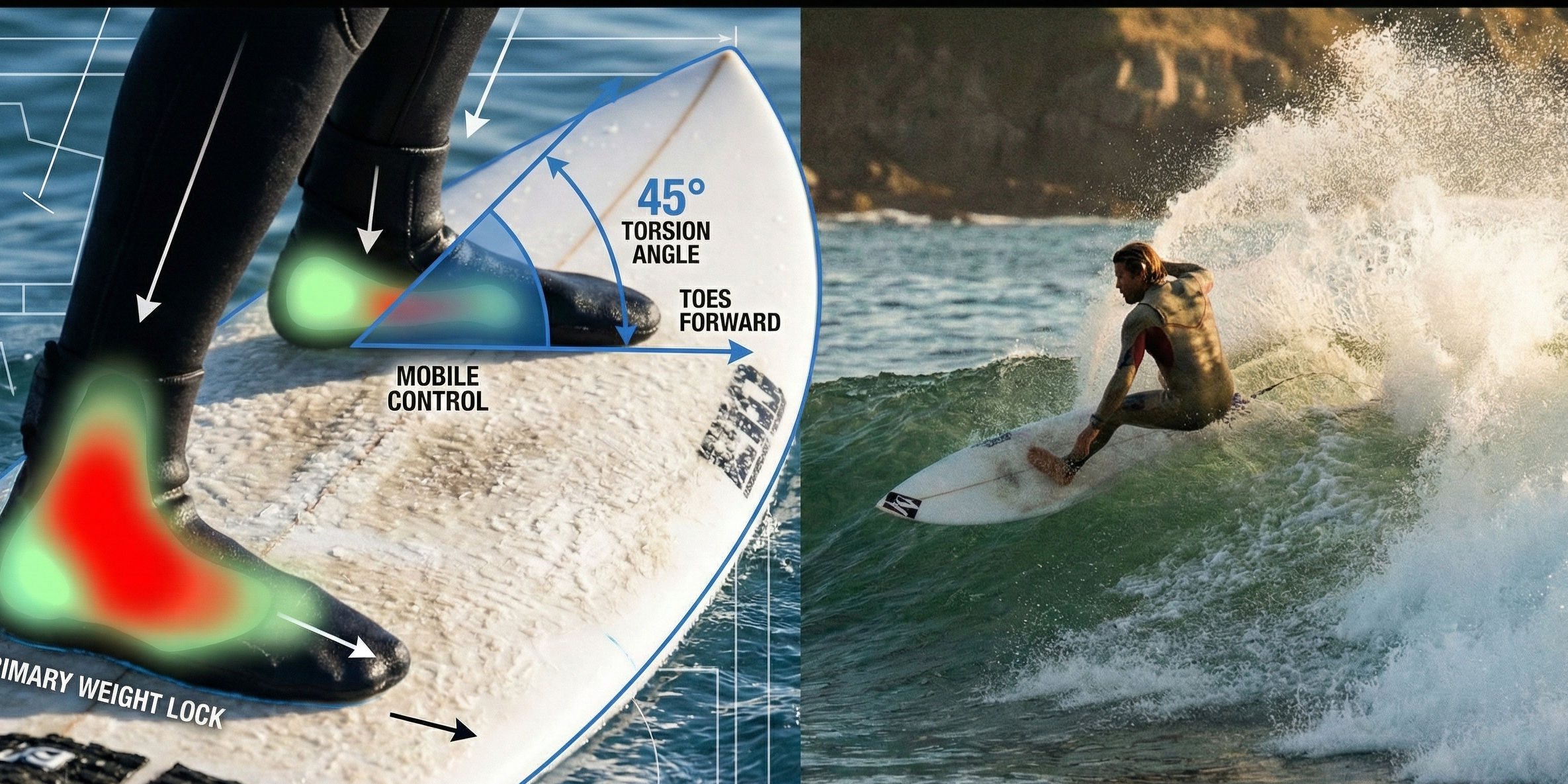
TL;DR: Modern board design requires a "balanced stance" rather than the legacy back-foot bias. Weighting the front foot unweights the tail, allowing the back foot to utilize 45-degree torsion for micro-adjustments in the pocket.
Master front-foot security to enable back-foot mobility.
The "back-foot power plant" is a relic of 1970s single-fin design. Back then, you had to pivot the board around a single point to avoid catching rails or nose-diving. If you’re riding a modern thruster or quad with contemporary rockers, that heavy back-foot bias is why your turns are dying at 90 degrees.
To Command the Tail, You Must Trust the Nose
The counter-intuitive truth of modern surfing: To gain precise control over your back foot, you must put more weight on your front foot.
By "locking" your weight over the widest, most stable part of the board (the front foot), you effectively unweight the tail. This "unweighting" is what allows for the subtle control, toe-to-heel shifts, and torsion required for high-performance surfing. If your weight is pinned to the back, the tail is buried, the rail is bogged, and the board becomes a blunt instrument.
Technical Contrast: Evolution of the Stance
1. Back Foot Angle
- Legacy Approach: 90 degrees, square to the stringer.
- Modern Approach: 45-degree angle, with toes facing half-forward.
2. Weight Distribution
- Legacy Approach: Heavy back-foot bias used as a pivot point.
- Modern Approach: Front-foot security (approx. 60%) that enables back-foot mobility.
3. Body Orientation
- Legacy Approach: Shoulders squared to the rail, leading to "arm waving."
- Modern Approach: Chest open toward the nose, facing the direction of travel.
4. Knee Position
- Legacy Approach: Back knee squared out, often dragging in the face during bottom turns.
- Modern Approach: Back knee tucked behind the front knee for increased torsion.
The Geometry of Control
In a balanced stance, your back foot is a section-checker, not a static weight. When you shift your back foot to a 45-degree angle, you naturally open your hips.
This adjustment clears the path for the "drop knee" sensation. As you transition through a turn, the back knee falls toward the deck of the board. It isn't a rigid posture; it’s a fluid weight shift. As you roll from heel to toe, the board responds to the torsion rather than just raw pressure. If you feel the "V" in the foam behind you, it should be a result of the rail slicing the water, not the tail digging a hole.
Coach’s Cue: "Stop trying to steer with your upper body. Think of your front foot as the security lock and your back foot as a sensitive dial."
Visualizing the Transition Point
When you are "balanced," you can feel the board rocking slightly under your feet. This is the transition point. By rolling forward slightly onto the front foot, the back foot gets an instant to shift or "unweight" to adjust for a closing section. This mobility is the difference between making a difficult barrel and getting clipped by the foam ball.
The Next-Session Blueprint
- The Pre-Surf Observation: Watch the best surfers in the lineup during their frontside bottom turns. Specifically, look at their back knee. Is it pointing out toward the beach (the "stink bug"), or is it tucked in toward the stringer? Notice how their chest is already facing the lip before they even reach the midpoint of the wave face.
- The In-Water Focus (The "Light Tail" Cue): On your first three waves, focus entirely on your front foot during the takeoff. Once you’re up, consciously "unweight" your back foot. Try to make a minor adjustment—move the back foot an inch forward or back—while the board is on the flats. If you can move the foot easily, you’ve achieved the balanced stance.